.png)
WKS 14 - Rebates Management
Workshop on to cover rebates management.
Participants
Name | Company | Role |
|---|---|---|
Teemu Salonen | Valio | Pricing Analyst |
Tomi Toivonen | Valio | Pricing Manager |
Omar Bendada | Ben Consulting Services | Business Analyst |
Sofia Simaria | Ben Consulting Services | Proxy Product Owner |
Kaoutar Bennadi | Ben Consulting Services | Developer |
Christiaan Van Eden | Pearson Ham Group | Consultant |
Goal
This workshop is for capturing all information about rebates that needs to be in the customer quote / agreement.
Workshop materials
Topic | Document | Comment |
|---|---|---|
Rebates requirements | CPQ, Pricing and Margin Calculations.xlsx 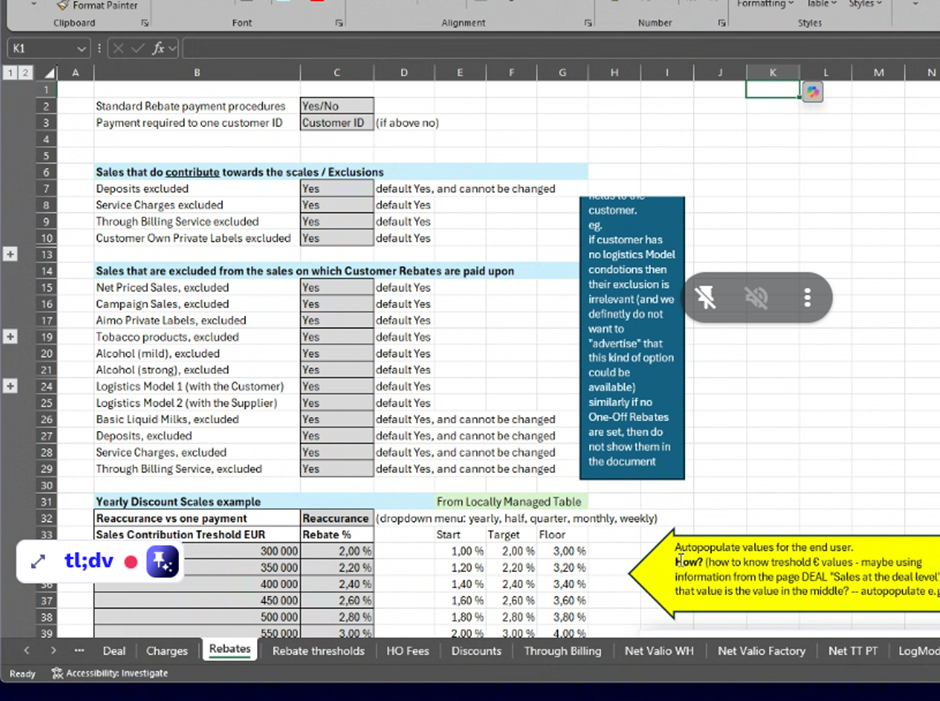 | Valio excel requirements doc |
 |
Main results
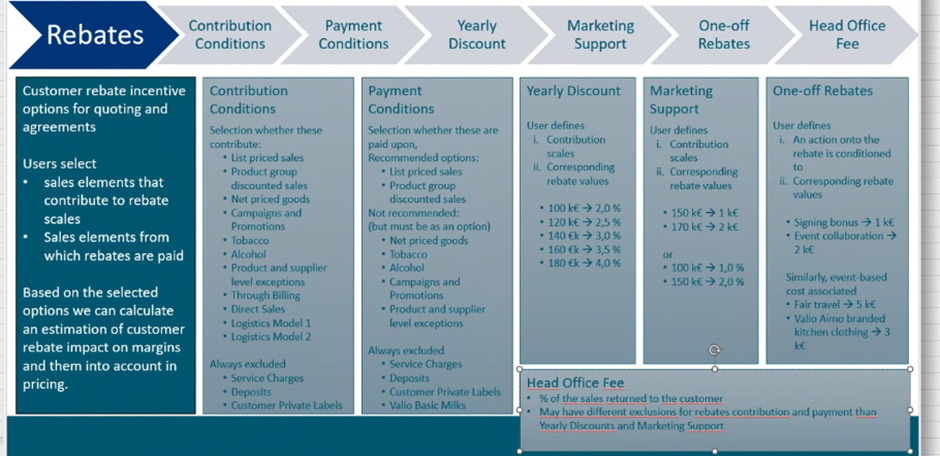
Sales that Contribute to Rebate Scales (Contribution Base):
Definition: This refers to the portion of sales that counts towards reaching specific rebate thresholds.
Inclusions/Exclusions:
Rebates are primarily paid on list price sales and product group discount sales.
Net price sales are generally excluded from rebate calculations, as they are considered the final price. The idea is that if an item is net priced, no additional rebates are applied to that line.
Specific products (e.g., alcohol, tobacco products) are often excluded from contributing to the rebate base or from receiving rebates.
The team will need to define which products are eligible for rebates (i.e., tagged as "eligible" at the line item level).
Impact: Even if a customer's total sales meet a threshold (e.g., €300,000), rebates might only be paid on a portion of that total (e.g., €200,000) if certain products or sales types are excluded from the contribution base.
Sales/Products that Rebates are Paid On:
Rebates are intended to be paid only on "list price sales and Product group discount sales".
Net-priced products generally do not receive rebates.
But this is defined in the specific table
Yearly Rebate Scales and Percentages:
Calculation Logic: The calculations for yearly discounts will involve formulas, which are to be detailed in an Excel file. This will make it easier to convert them into CPQ code. These formulas will be developed during the week of June 9th.
Pre-population & Editability: The expectation is that when a sales representative accesses the rebates page, recommended scale values and rebate percentages will be pre-populated based on the deal size. Sales representatives will have the ability to edit these values; if scales are edited, the rebate percentage should dynamically adjust, but the percentage can also be directly overridden.
Default Application: The scales and percentages are intended to be suitable for all customers, with minor variations for specific percentages based on other sales representative conditions.
Marketing Support:
Calculation: Marketing support rebate calculations use a slightly different, often simpler, formula compared to yearly rebates. Instead of percentages, they often involve fixed Euro amounts tied to purchase targets (e.g., €2,000 for buying over €500,000).
No Pre-population: Unlike yearly discounts, marketing support fields (thresholds) should not be pre-filled as default. They should be empty by default because these are much rarer cases.
Fixed Payout: The marketing rebate amount (e.g., €2,000) is a fixed payout and will not go below that value, even if the contributing sales include net-priced items (if those are configured to contribute to the threshold).
One-Off Rebates:
Exclusions: One-off rebates (e.g., "signing bonus," "travel") are not connected to the "yes/no" exclusion rules applied to other rebate types.
Minimum Purchase Condition: For one-off rebates (like a signing bonus), there should be a minimum purchase threshold (e.g., €100,000 worth of goods) to ensure customers don't just sign contracts for the bonus without purchasing. This condition needs to be formally documented.
Comment Column: A comment column should be added for one-off rebates to provide context for the specific event (e.g., "cooperation summer holiday").
Additional Rebate Information:
A free-text field will be added for "additional rebates information," specifically to allow specifying an alternative customer ID (different from the primary customer ID) to which the rebate payment should be directed. This is for cases where a purchasing group or different invoicing entity is involved.
Action list
- Tomi to finalise Excel formulas for rebate calculations (yearly and marketing) and share for review.
- Tomi and Teemu to finalise structure and values of rebate scaling tables (yearly + marketing).
- Define the technical logic and fields for rebate eligibility tagging at line-item level.
Decisions
List of requirements
Ensure rebate impacts are reflected correctly in quote-level margin computations.