.png)
WKS 15 - Agreements Management
Workshop on to cover agreements management.
Participants
Name | Company | Role |
|---|---|---|
Teemu Salonen | Valio | Pricing Analyst |
Tomi Toivonen | Valio | Pricing Manager |
Omar Bendada | Ben Consulting Services | Business Analyst |
Sofia Simaria | Ben Consulting Services | Proxy Product Owner |
Kaoutar Bennadi | Ben Consulting Services | Developer |
Alain Becker | Pearson Ham Group | Operations Manager |
Goal
This workshop aims to define how customer agreements are managed, stored, and applied within the sales and CPQ process.
Workshop materials
Topic | Document | Comment |
|---|---|---|
Agreement and related objects | 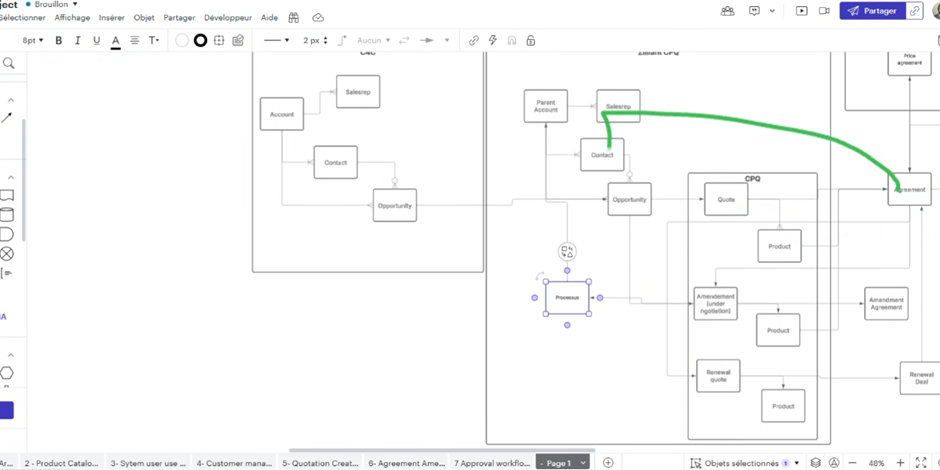 | |
Main results
Agreement Amendment
Trigger: An amendment is required when there's a change to the content or scope of an existing agreement, such as adding or deleting products, or changing specific prices agreed upon within the contract.
Process: When an amendment is created from an existing agreement, new records are generated with a new start date and end date for the changed items.
System Impact: Creating an amendment means creating a new quote (or "agreement under negotiation") that will go through the same approval process (price approval, sales approval) and document generation as an initial quote. The proposed products in the amendment should still be offered by Valio.
Mass Changes: Mass changes to products (e.g., product end-of-life replacement across many contracts) should be managed via mass change functionality, like in other systems.
Updating Prices During Agreement (Agreements Mass Price Updates)
Distinction from Amendment: Price updates that simply adjust the net prices within an existing agreement, without changing the product scope, do not require a full amendment or a new quotation process.
Frequency: Price updates typically occur every four months in yearly deals. They are generally monthly operations, often done on the first day of the month, with peak times at the beginning of the year (January 1st), May 1st, and September 1st.
Driver: Price updates are driven by cost changes (e.g., raw materials, production costs) which are reflected in new target prices from Price IQ.
Location of Update (Price Manager vs. CPQ):
Decision: Mass price updates for agreements should be implemented in Price Manager, not CPQ.
Reasoning: Price Manager is better suited for handling mass updates (e.g., 5,000 to 50,000 lines per month). It contains transactional data, historical costs, and the full margin waterfall for every transaction line. Salespeople do not have direct access to Price Manager.
CPQ's Role: CPQ can be used for initial deal-level profitability calculations and proposal generation. Salespeople (account owners) should use CPQ for reviewing updated prices.
Process Flow for Price Updates:
Back office people update prices in Price Manager, reflecting new costs and guidance.
The updated prices (net price line items) are communicated to the CPQ system and associated with the agreement.
Sales representatives are informed of these price updates within the agreement in CPQ.
Sales representatives can then generate a new document to share with the customer for information or acceptance.
Impact Calculation: The impact calculation for price updates will focus on net price line items using historical volume, old costs/prices versus new costs/prices. This is a simpler approach than recalculating the entire deal profitability.
Information like product group discounts are already present in Price Manager as conditions from ERP.
Information from CPQ such as new start and end dates for prices from the next period should be sent to Price Manager.
Agreement Renewal
Process: Renewal can be created automatically. The process of creating a renewal is similar to creating a new amendment in that everything will be recalculated based on updated rules in the system (e.g., new prices, product changes).
Output: Renewals will also generate a "quote" (agreement under negotiation) that goes through the standard approval and document generation process.
Zilliant Product Features (Quote versus Agreement)
Quote vs. Agreement: The main difference is that an agreement has a fixed start and end date, defining a time frame for its elements, while a quote is a spot-based item.
"Agreement Under Negotiation": It was suggested that what is currently termed a "quote" in CPQ could be relabeled "Agreement under Negotiation" to better align with the business process of creating agreements. This needs to be clarified with the Zilliant team as it relates to new, developing functionalities.
UI Enhancements: Zilliant is planning to enhance the UI of its platform.
Where to Implement Mass Price Updates (Price Manager vs. CPQ)
As detailed above, the decision is to implement mass agreement price updates in Price Manager due to its capabilities for handling large volumes of transactional data and its role in ERP integration.
CPQ will serve as the interface for sales teams to review these updates and manage customer-facing documents.
Other Relevant Considerations:
Agreement Visibility: There is a requirement to access agreements directly from the customer or opportunity level within the system, potentially via a dedicated list or button.
Linking Agreements to Opportunities:
It was debated whether agreements should be linked to opportunities or directly to accounts.
The preference leaned towards linking agreements to opportunities to maintain alignment with a CRM structure (C4C) in the future.
The idea is that an opportunity could be created for a quote/proposal, and then closed when the deal is won and agreement generated. A new opportunity could be generated for price updates or renewals.
This approach avoids potential future "headaches" if C4C becomes the main CRM and entry point, and requires seamless synchronization of information between objects.
Data Storage: The system will store agreement details (customer, agreement ID, product, price, start date, end date) in a "Price Agreement" table in Price Manager, allowing for new records with new dates for price changes.
Action list
Decisions
- Mass price updates for agreements should be implemented in Price Manager, not CPQ.
- The impact calculation for agreement mass price updates will focus on net price line items using historical volume, old costs/prices versus new costs/prices. This is a simpler approach than recalculating the entire deal profitability.
List of requirements
Agreement Amendment Functionality:
Implement a trigger for amendments when there are changes to agreement content, scope, or specific agreed prices.
Develop a process to create new records with new start and end dates for changed items when an amendment is initiated.
Ensure that creating an amendment generates a new "quote" (or "agreement under negotiation") that follows the existing approval and document generation processes.
Verify that proposed products in an amendment are currently offered by Valio.
Develop mass change functionality for product updates (e.g., end-of-life replacement) across multiple contracts.
Mass Price Update Functionality (in Price Manager):
Implement mass price update capabilities within Price Manager for agreements, distinct from the amendment process.
Configure Price Manager to handle large volumes of price updates (e.g., 5,000 to 50,000 lines per month).
Ensure Price Manager can process price updates driven by cost changes and new target prices from Price IQ.
Develop a communication mechanism to send updated net prices from Price Manager to the CPQ system, associating them with the relevant agreements.
Enable Sales Representatives in CPQ to review these updated prices.
Provide functionality for Sales Representatives to generate new documents reflecting updated prices for customer communication.
Implement an impact calculation for price updates focusing on net price line items, using historical volume, old costs/prices versus new costs/prices.
Develop functionality to send new start and end dates for prices from CPQ to Price Manager for the next period.
Session recording
https://tldv.io/app/meetings/6836decee556b90013569706/