.png)
WKS 9 - Product Pricing and Discount Structure
Workshop on to cover structure of product pricing and discounts .
Participants
Name | Company | Role |
|---|---|---|
Teemu Salonen | Valio | Pricing Analyst |
Tomi Toivonen | Valio | Pricing Manager |
Omar Bendada | Ben Consulting Services | Business Analyst |
Sofia Simaria | Ben Consulting Services | Proxy Product Owner |
Kaoutar Bennadi | Ben Consulting Services | Developer |
Goal
This workshop is for capturing modeling the price structure for the sold product within the configuration process.
Workshop materials
Topic | Document | Comment |
|---|---|---|
Pricing Structure | 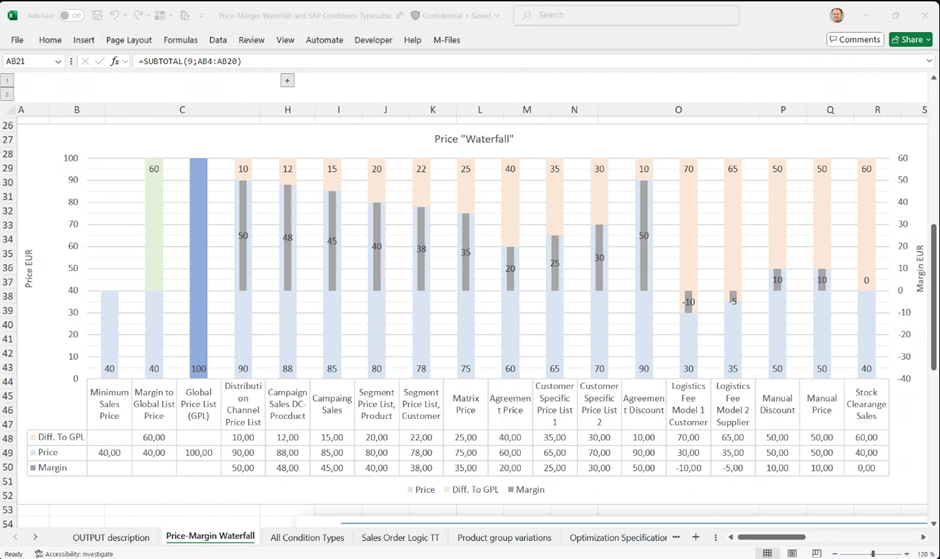 screenshot | Valio’s Pricing Waterfall Components |
Segment Price Lists structure | 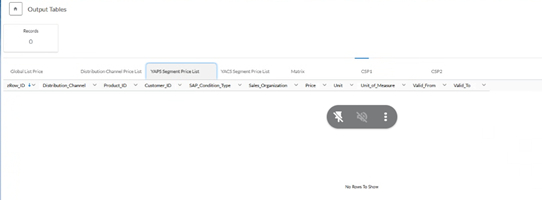 | Structure of output tables in Price Manager |
Main results
Pricing Logic / Pricing Waterfall Components
Start with MSP (total purchasing cost)
Apply various strategies in Zilliant to derive a Global List Price
This is anchor point from where we come down to other prices
Distribution Channel List Price
Cash and Carry (stores)
PIQ for non-negotiation guidance (incl elasticity > optimal price)
Delivery (currently 2 channels but goal is to have a unified channel)
Valio Direct
FSD Channel wholesale business that Valio bought to grow and expand
Segment Price Lists – open to all customers currently; which price is paid, is determined at the sales order time depending on which prices are available. SAP compares and takes lowest / strongest condition. So, we end up having multiple prices available.
Product Segment Price Lists, eg
Fruit & Veg
Fish/Meat
Wines and Spirits
…
Customer Segment Price Lists, eg
Pizzeria
Cafeteria (S/M/L)
…
Matrix Price
Comes from PIQ. Product Group Level 3 x Parent Customer Level
In CPQ we define Product Group Discounts – this is the ‘promise’, but the specific discounts come from the PIQ matrix price directly into SAP (matrix price)
Product Group Discounts in CPQ will fall before the Matrix Price; Applicable to Distribution Channel Price List
Agreement Price in Waterfall = Net Price set in CPQ
CSP list 1 and 2 are something exceptional, try not to use them
1) Price-Product in Agreement
2) Adjust matrix value discount on product group
Agreement discount – typically we don’t do them
Manual Price > eg mistake in picking, wrong products, costly for us we offer some discount to customer – SAP, not relevant for CPQ
Detailed meeting notes below.
Pricing Strategy Overview
Workshop focuses on calculating product pricing and understanding pricing strategies for executing sales process and generating quotes.
Pricing strategy starts with minimum selling price (MSP) and develops price waterfall from there.
Company uses multiple strategies to derive global list price as an anchor point for further pricing.
Pricing varies across distribution channels: custom carry business, direct value SAP, and FSD wholesaling business.
Currently no product bundling or 'buy more, pay less' pricing strategies are implemented.
Plan to develop price lists with different tiers for customer segments (large, medium, small)
Pricing strategy to cascade from global price to distribution channel, campaigns, segment pricing, and customer-specific agreements
Company wants to optimize pricing by providing strategic discounts instead of blanket percentage reductions.
Matrix pricing strategy aims to avoid complex discount communication that customers might not understand.
Customer Segmentation and Price Lists
Segment price lists are based on product segments like fruits, vegetables, meat, and potentially spirits.
Future pricing strategy may include differentiated pricing for different customer groups and deals.
Proposal to create customer-specific price lists segmented by business type (pizzerias, restaurants, street food, lunch places)
Customer-specific price lists serve as backup tools to manage profitability and adjust pricing
Two primary pricing adjustment methods: Product/agreement price and matrix value discounts
Plan to implement product group discounts in CPQ system based on customer profiles
Product group discounts are meaningful for customer pricing strategies.
Current master data lacks detailed customer segmentation beyond basic group classification
Future goal to simplify and align price list setup with project segments
CPQ System Integration
CPQ to display net price from Price IQ with sales rep override capability, tracking distribution channel.
Distribution channel price lists will serve as reference points for pricing.
Ideal CPQ functionality would pull segment price list information for specific customers and products.
Goal is to provide flexible pricing views that sales reps can customize based on customer segment and quoting needs.
Product discounts in CPQ will represent a minimum guaranteed discount to customers.
Sales team seeks net price visibility across channels and segments, recommends Price IQ targeting.
CPQ will query pricing data on-demand instead of replicating entire dataset
Team discussing price list configuration across product groups and supplier levels
Price lists created and mapped to specific customers
New customer addition process involves adding customers to existing price lists
Pricing Visualization and Context
Plan to include company internal guidance values and competition authority restrictions in background lookup tables
Sales want guidance values and ability to see pricing for similar customers, potentially through visual timeline graph
Exploring button at line level that displays pricing graph for additional context
Action list
Decisions
List of requirements
Display relevant list prices (distribution channel, customer segment, product segment) for the sales rep to analyse when setting the agreement net prices in CPQ
Display net price S/T/F recommendation
Display the additional guidance – from authority, and valio (discussed in previous workshop)
Ability to define and select the different views in CPQ - for the Net Prices screen
Ability to see peer pricing - scatter plot with transactions showing how much similar customers have historically paid for that product. ( x=time, y=price, S/T/F > Zilliant has promised this viz in CPQ (user story at least – how to implement is TBD; possibly having Z team building and publishing the graph in tableau and then from CPQ we do a call for the given product and customer)
CPQ integration with Price Manager to use product-customer combination for price lookups across the various price lists
Session recording
https://tldv.io/app/meetings/682d7a1d2612c900133512aa/